
Insperium Chinese
Chinese Graded Readers: The Complete Guide (2026)
Updated October 5, 2026 · 7 min read

Chinese graded readers are books written inside a deliberately limited vocabulary — a few hundred words at beginner level, a few thousand higher up — so you can read real stories instead of decoding a dictionary. They work because of comprehensible input: when you understand nearly every sentence, you acquire the language from context, not just from flashcards. This guide covers what graded readers are, why extensive reading is so effective, how reader levels map to CEFR and HSK, what separates a good series from a padded one, and how our model at Insperium — 33 classics, each rewritten at six levels, so you reread the same book as you grow — differs from the usual one-book-one-level approach. The short answer for anyone comparing options: pick whatever gets you reading a lot, at a level that feels almost easy.
What Are Chinese Graded Readers?
A graded reader is a book written inside a strict vocabulary budget. An A1 reader may use only the most common few hundred words; a B2 reader can draw on a few thousand. Sentence patterns are controlled the same way, introduced gradually rather than all at once. The result is text that teaches you something on every page but never lets you lose the plot.
That makes graded readers different from three things they get confused with. Textbook dialogs are too short and stilted to build reading stamina. Parallel texts put native-level Chinese next to an English translation, which mostly trains you to read the English. And children's books are written for native speakers who can already talk — their vocabulary is famously hard for learners. The graded readers Mandarin students actually finish are written for adult learners, from the ground up, at a stated level, usually with pinyin support and audio.
Why Extensive Reading Works: Comprehensible Input
The idea behind extensive reading is old and well tested: you acquire a language fastest from input you can almost entirely understand. Stephen Krashen called it comprehensible input; reading researchers such as Paul Nation put a number on it, finding that comfortable reading requires knowing roughly 98 percent of the words on the page. Below that threshold you are not really reading — you are doing dictionary work with extra steps.
Two practical consequences follow. First, easy is correct. Reading below your frustration level is not cheating; it is the mechanism. Every sentence you understand effortlessly is one more repetition of real grammar and vocabulary in context, and the volume of those repetitions is what moves you forward. Second, you need a large supply of material at your level, because you will get through it faster than you expect. That is why we publish short-form material alongside the books: graded stories and dialogs across 18 everyday topics, with pinyin and English support, and the stories with audio at normal and slow speed. A free sample set opens with no account on the Chinese stories page, and every story and dialog we have checked by hand — several hundred so far, with more each week — is included in the Insperium membership.
How Graded-Reader Levels Map to CEFR and HSK
Publishers grade by unique-word counts, but the CEFR scale (A1 up to C2) is the useful common language — and most Chinese learners think in HSK. A realistic mapping looks like this:
- A1 ≈ HSK 1–2 — roughly the first 150–300 words
- A2 ≈ HSK 3 — about 600 words
- B1 ≈ HSK 4 — about 1,200 words
- B2 ≈ HSK 5 — about 2,500 words
- C1 ≈ HSK 6 — about 5,000 words
Note the word realistic. The official HSK-to-CEFR claims run about one band higher (HSK 4 officially claims B2, for example), and most teachers find the modest mapping above closer to the truth; the newer HSK 3.0 standard reshuffles things again into nine bands. So when you shop for Chinese graded readers, ignore the label on the cover and apply one test instead: open a sample page. If you understand nearly every sentence without help, it is your level. If you are not sure where you stand at all, start one level lower than you think — a book that is too easy costs you an evening, one that is too hard costs you the habit.
Here is what the difference between levels looks like in practice: the same small event, told three ways.
A1 Simple sentences
小王回家了。他很累。他喝了一杯水。
Xiao Wang came home. He was tired. He drank a glass of water.
A2 Connected ideas
小王回到家,因为很累,所以先坐下来,喝了一杯水。
Xiao Wang got home. Because he was tired, he first sat down and drank a glass of water.
B1 More detail
小王忙了一整天,回到家时已经很累了。他先坐下来喝了一杯水,然后才开始准备晚饭。
After a busy day, Xiao Wang was already tired when he got home. He sat down for a glass of water before starting to prepare dinner.
What to Look For in a Graded Reader
- Genuine vocabulary control. Some books slap a level on the cover and then lean on footnotes for every fifth word. Sample a page and count how often you need help.
- Audio at two speeds. Listening while reading links characters to sound. A slow speed matters more than beginners expect.
- Pinyin you can hide. Pinyin is scaffolding, not the destination. If it is printed under every line and cannot be removed, your eyes will read it instead of the characters.
- A story worth finishing. Extensive reading only works if you keep going. A dull story at the right level loses to a great story at the right level every time.
- A ladder above and below. You will need the next level sooner than you think — and sometimes a step back down for confidence.
- Some way to keep the words. New words you meet while reading should feed a review routine, or most of them will wash away.
One Classic, Six Levels: How Insperium Does It
Almost every graded reader on the market exists at exactly one level. You read it, you shelve it, and the next book is a new world with new names and a new setting. We built the Insperium library the other way around: 33 world and Chinese classics, and every single one exists at all six levels — A1, A2, B1, B2, B2+ and C1. You do not outgrow a book; you outgrow a version of it. The books are in their final edit and open soon; every book page already shows the story, its main characters and a sample passage from each level.
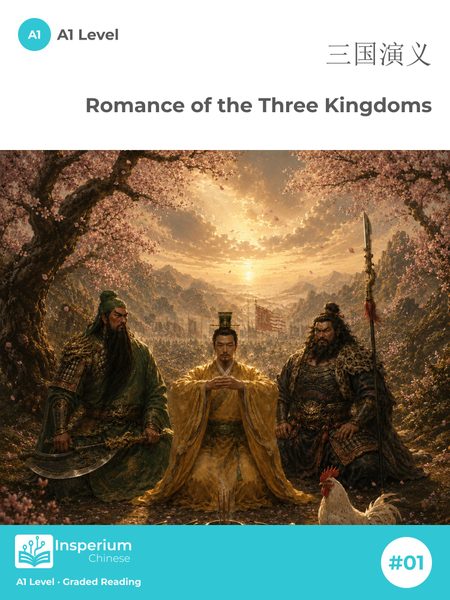
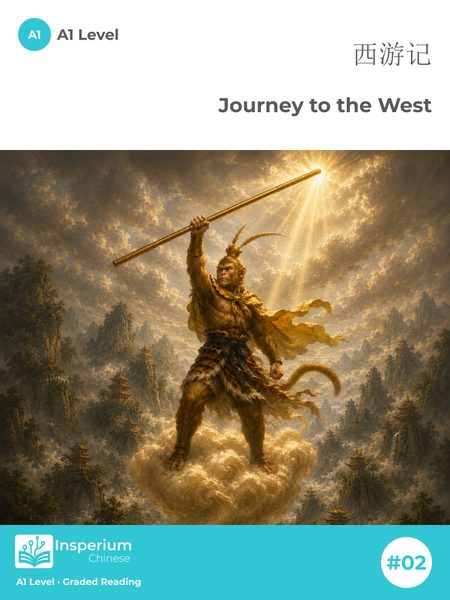
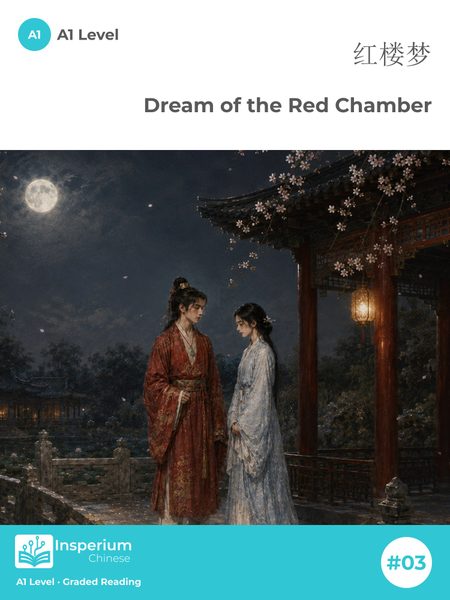
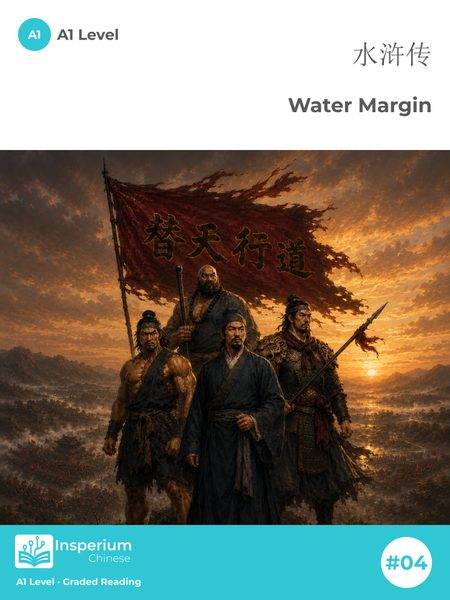
Rereading a familiar story one level up is quietly powerful. Because you already know the plot, your attention is free for the language itself — you notice how the A2 version says plainly what the B1 version implies. It is also the most honest progress bar in language learning: the same ghost story that took you a week at A2 reads in an evening at B1, and nothing motivates like that comparison.
The books are interactive courses, not PDFs. Tap any word for its meaning, toggle pinyin on or off, and follow karaoke-style audio where each word highlights as it is spoken, at normal or slow speed. Words you save go into a Leitner drill — spaced-repetition boxes with intervals from 6 hours to 30 days — so vocabulary from chapter three still exists in your head by chapter ten. When the books open, they are sold individually, separate from the membership.
Paper Readers vs Story Apps vs Interactive Books
All three formats can work. Here is how they actually differ:
| Paper graded readers | Story apps | Insperium | |
|---|---|---|---|
| Material | Single-level novellas | Short graded stories | 33 full classics, each at 6 levels (opening soon), plus graded stories and dialogs |
| Audio | Sometimes, via download | Yes | Karaoke audio at normal and slow speed, words highlighted as spoken |
| Word lookups | Manual glossary or dictionary | Tap words | Tap words, pinyin toggle |
| Built-in review | None | Varies by app | Leitner boxes, 6-hour to 30-day intervals |
| When you level up | Buy different books | Read different stories | Reread the same classic at the next level |
| Cost model | Per book | Usually a monthly subscription | Books sold individually (opening soon); hand-checked stories and dialogs come with the membership — $1 for the first 7 days, then $29/month |
To be fair to the alternatives: paper is wonderful if screens tire you, and story apps are a fine source of daily input — the established ones have a far larger library of short stories than ours today (we compared the main options in a separate post). What a story app cannot give you is the same book at the next level. Our bet is that the combination is the product: long-form classics you can grow into, short-form stories to fill the gaps, and a drill system that keeps what you read.
Where to Start
You do not need to buy anything to find out whether extensive reading suits you. Open the free story and dialog samples on the Chinese stories page — no account needed — and give them the sample-page test from above.
If the samples feel like decoding rather than reading, the problem is not the stories. It is the characters. Every graded reader assumes you already recognise the characters at its level, and a small set does most of the work: in Jun Da's frequency count of modern Chinese, the 1,000 most common characters make up about 89% of everyday text, and the 2,500 most common about 98.5%. Those 2,500 are what Character Mastery teaches — in frequency order, drilled in sets of look-alikes so you learn to tell 未 from 末, with meanings in your own language: English, Dutch, German, Spanish, French or Italian. It is $1 for the first seven days, then $29/month, and members also read every hand-checked story and dialog.